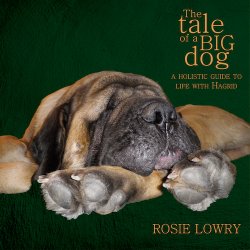
The Tale of a BIG Dog, follows on seamlessly from Rosie Lowry’s first book, Understanding the Silent Communication of Dogs. It is full of ideas and inspiration giving us the confidence to consider a range of insightful approaches to improve our dogs’ lives.
PRICE REDUCED TO *£14.99 * PLUS FREE SHIPPING IN THE UK
When Rosie Lowry decided to take home Hagrid, a two-year-old Mastiff with health issues, little did she know what kind of a life journey she was embarking upon.
That journey was one of learning for both human and dog. In an effort to deal with Hagrid’s changing needs, Rosie had to venture into uncharted territory. Life with Hagrid was a rollercoaster ride, with experiences ranging from dealing with unwanted behaviour to more health issues than Rosie had thought possible! Working with vets, exploring complementary therapies, finding out more about diet, venturing into self-selection, Rosie’s journey included a foray into many of the practical issues surrounding dog guardianship. One key piece of advice leading from this: learn to question.
However, dealing with Hagrid’s physical needs of course, was only one aspect: there was also the process of building a trusting relationship and overcoming emotional issues.
Even the everyday, ordinary aspects of life proved to be a challenge that Rosie had to rise to.
This book is Rosie and Hagrid’s story.
Sheila Harper B.Ed, B.A.
Who is this book for?
• Anyone adopting or fostering large breed or rescue dogs
• Families introducing dogs to children and other pets
• Those interested in holistic or complementary veterinary care
• Anyone who wants a practical and reflective guide to deepening empathy and communication with their dog
“The Tale of a BIG Dog: A holistic guide to life with Hagrid” is a comprehensive, practical, and personal account about living with a giant rescue Mastiff, Hagrid, covering everything from introduction and integration into a new home to unique perspectives on health, walks, canine communication, and even end-of-life care.
Book Structure and Major Themes
1. Personal Journey
• The book is a personal memoir and guide, starting with Hagrid’s end-of-life and the grieving process, then reflected upon in detail.
• Rosie shares honest emotions around loss, mistakes made, and growth experienced, all with real-life anecdotes.
2. Dog Integration & Relationships
• Detailed advice on integrating a new (especially rescue) dog:
• Taking introductions slowly, using dog gates, and respecting boundaries.
• Parallel introductions to existing dogs, slow and supervised expansion of space, and the importance of rest.
• Emphasis is placed on thoughtful preparation and patience, drawing parallels to raising children.
3. Living With and Understanding Large & Sensitive Dogs
• Rosie highlights the differences (and challenges) in having a ‘big dog’: their care needs, health, the emotional impact, and requirements for space.
• Consideration for their needs in the home, with children, visiting grandchildren, and other animals.
• Focus on understanding dog communication—especially subtle forms often missed or misinterpreted (e.g., play bows aren’t always play, wagging tails aren’t always happy).
4. Holistic & Individualised Care
• Rosie offers practical, day-to-day advice on enrichment, walks, food, rest, preparation for vet visits, and reading body language.
• Stresses the importance of health tracking (keeping notes, recognising patterns).
• Explores alternative therapies: homoeopathy, acupuncture, and zoopharmacognosy (self-selection of healing substances).
• Strong, repeated arguments for slow, gentle, empathetic, and individualised approaches— “less is more,” letting each dog set its pace.
5. Health and Lifestyle
• Chronic health problems (especially skin/ear issues) are explored in depth, with detailed descriptions of treatments, responses, and the role of diet and stress.
• The impact of medication, the value of a natural diet, and the balance between veterinary and complementary medicine are all discussed.
• Hygiene and practical care with big, drooly, sometimes unwell dogs is addressed (towels everywhere, cleaning, adaptations of the home, custom ramps, etc.).
6. Philosophy: Empowerment, Choice, and Respect
• Rosie advocates for trusting the dog’s choices where safe, building their confidence through controlled options and positive experiences.
• Emphasis on cooperative vet care, being an advocate for your animal (even when that means challenging professionals or norms).
• The book is laced with broader reflections on how society undervalues animal agency and prioritises human routines over animal welfare.
7. Practical Strategies
• Key points at the end of each chapter for quick reference.
• Real-life scenarios and problem solving (e.g., how to handle scavenging, excitement near water, group walks, handling barking, etc.).
• Guidance for handling sensitive times such as visits to the vet, introduction to children, and end-of-life decisions.
• References and further resources provided for deep-dives (books, online resources, key contacts).
8. End-of-Life Care
• Includes an unflinching, emotional description of Hagrid’s final days and euthanasia, as well as the impact on the household.
• Honest advice on grief, guilt, and closure for the owner and other animals.
Summary Takeaways
• Go slow, be open, listen: Each dog is different. There’s no ‘one size fits all.’ Watch for individual preferences, especially for rescues and special-needs dogs.
• Health and behaviour are deeply linked: Physical and mental wellness, medical events, household changes, and relationships all impact dog behaviour and happiness.
• Communication goes both ways: Learn to read your dog’s cues, and be willing to adapt your life and expectations to build trust and confidence.
• Collaboration with professionals: Respect your own knowledge as a carer but seek and coordinate with veterinary and alternative health experts.
• Practicality in the real world: Accept mess, adapt your environment for their comfort (especially for big/senior dogs), and balance animal needs with human routines.
• Empathy and respect: Dogs, children, and other animals benefit equally from boundaries, safety, patience, and opportunities for their voices to be heard.